
FEC Definition
The key idea
The key idea of Fallen Earth Creationism is that the original creation actually existed and was genuinely “very good.” It was unfallen, supernatural, and very different from the creation visible today. It contained Adam and Eve, the Garden of Eden, the Tree of Life, and the direct presence of God described in Genesis.
After the Fall, Adam and Eve left that original creation and entered the fallen creation inhabited today. From their perspective, the change was immediate. The world they entered was the natural world described by modern science, with an ancient cosmos, an ancient earth, biological evolution, suffering, predation, and death.
This means there were, in a sense, two creations. The original creation existed on a timeline separate from the history of the present universe. Its history is given in Genesis and is not available for scientific investigation. The fallen creation has its own real and coherent history, which is available to scientific study.
Cause and chronology
FEC distinguishes the cause of the fallen creation from the sequence of events inside it.
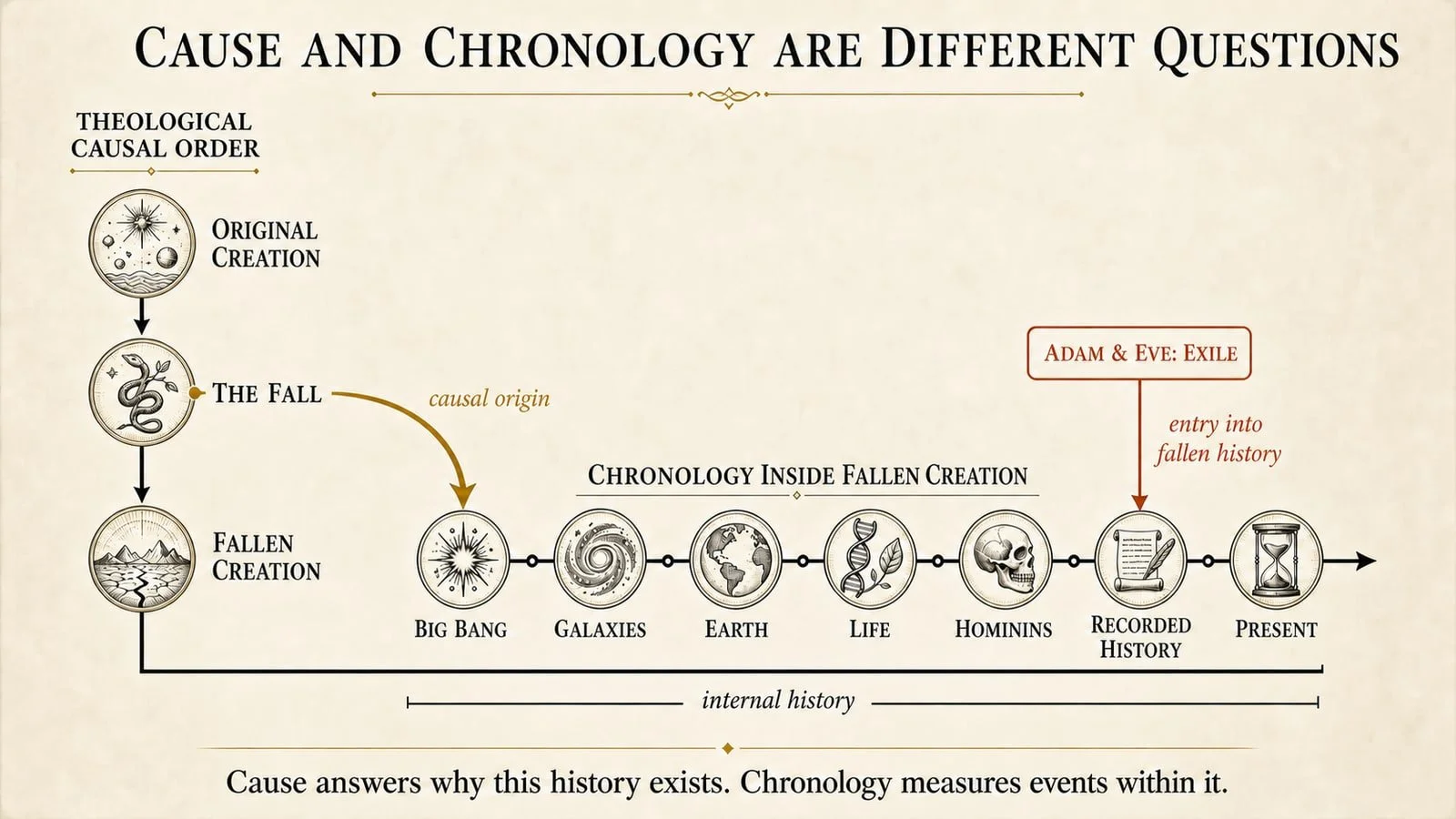
FEC places the Fall before fallen natural history in causal order, while Adam and Eve enter much later within that history’s own chronology.
Within the fallen world’s chronology, the Big Bang, the formation of galaxies and planets, the history of life, and the appearance of human populations take place across billions of years. Adam and Eve enter this history at a much later point.
From the theological point of view, their Fall is the reason this entire fallen order exists. The Fall is causally prior to the Big Bang, but not temporally prior on the fallen world’s own clock. The present cosmos has always been fallen.
Adam and Eve therefore lived in both creations. They experienced the original creation, made their choice there, and then entered the fallen world without experiencing its immense passage of time.
The scope of the proposal
FEC is a proposed reconciliation of two accounts that often appear impossible to hold together: the Genesis account of a good creation and a real human Fall, and the scientific account of an ancient natural world.
It does not prove Christianity or turn Genesis into a scientific account. It does not provide a new mechanism for cosmology or evolution. It proposes that science and Genesis are describing two different conditions of creation and two different histories.
FEC is offered as a plausible explanation, not as a problem-free or necessary doctrine. Details such as the location of Eden, the precise way Adam and Eve entered fallen history, their relationship to other human populations, and the implications for later Genesis remain open to examination.