
Start Here
A possible way of understanding Genesis and an ancient world
Christians are often presented with a difficult choice. Genesis can be treated as substantially true while the scientific account of an ancient universe is rejected, or the scientific account can be accepted while Adam, Eve, and the Fall are treated as something other than real history. Fallen Earth Creationism, or FEC, proposes another possibility.
The central idea is that the Fall of man brought about not only a fallen present and future, but also a fallen past that appears to precede Adam and Eve. The simplest explanation is that the creation God called “very good” and the fallen creation inhabited today belong to two different histories.
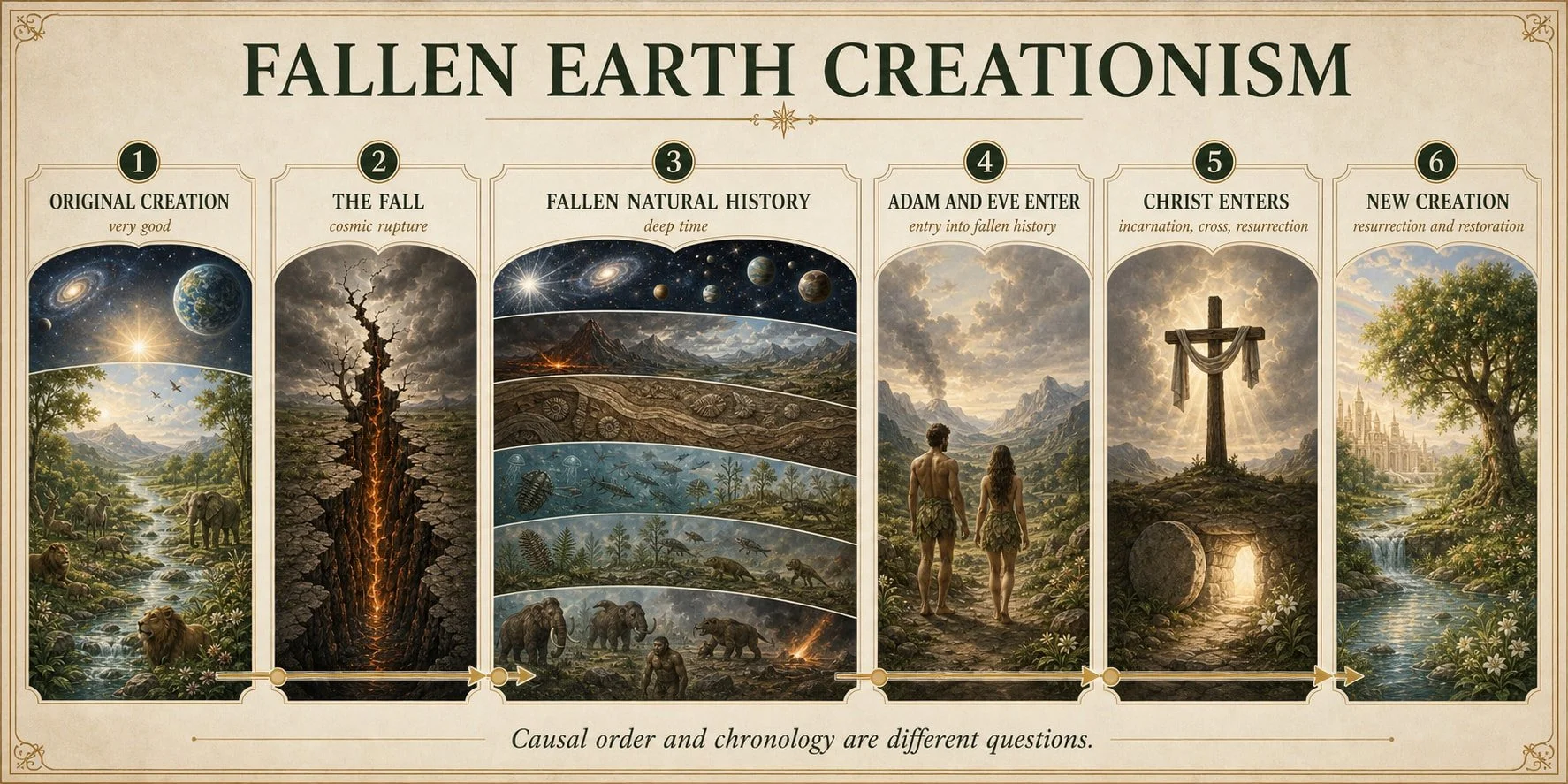
The six-movement FEC map places original creation, the Fall, fallen natural history, Adam and Eve, Christ, and new creation in causal order.
FEC in one paragraph
Fallen Earth Creationism proposes that God made a real original creation that was very good, including Adam and Eve; that their disobedience caused a real cosmic Fall; and that the universe described by modern science is the coherent fallen order that resulted. Cosmic development, geological deep time, biological evolution, predation, suffering, extinction, and evolved human populations belong to the history internal to the fallen creation. Adam and Eve experienced the original creation and the Fall directly, then entered a fallen world whose internal history was already ancient. Science therefore tells the truth about fallen natural history while Genesis tells the truth about the original creation, the human rupture, and why the present order is fallen.
The problem FEC is trying to solve
The scientific history of nature contains suffering, predation, disease, extinction, and death long before human beings appear. Genesis, meanwhile, describes creation as good and then very good, presents Adam and Eve as real participants in a human rupture, and connects their disobedience with judgment, mortality, and exile. The New Testament continues to connect Adam, sin, death, Christ, resurrection, and the hope that creation itself will be freed from corruption.
That creates pressure. A Christian can reject deep time and common descent in order to protect a historical Adam and a cosmic Fall. A Christian can accept the scientific history while treating Adam and Eve mainly as symbols. Or a Christian can accept the scientific history but place billions of years of suffering and death inside God's original creative process before human sin.
FEC asks whether all three approaches share an assumption that may not be necessary: that the original creation described in Genesis and the fallen world studied by science must belong to one continuous ordinary timeline.
Two histories, not two truths
The first creation contained the Garden of Eden and was the setting for Adam and Eve's creation, their life with God, the divine command, and the Fall. FEC allows that original order to have been as different from mortal nature as resurrection life is from the life we know now. Calling it very good need not require us to call predation, cancer, parasitism, and extinction features of the unfallen ideal.
After the Fall, Adam and Eve were cast out of Eden and entered the present fallen creation. This universe has its own complete and genuine natural history. Stars formed, the Earth became ancient, organisms lived and died, species changed, ecosystems came and went, and human populations emerged. These events are not illusions or a false appearance of age. They are the real history available to cosmology, geology, paleontology, genetics, and the other sciences.
FEC therefore does not propose two competing kinds of truth. Genesis tells the truth about the original creation, the human rupture, and why the world is fallen. Science tells the truth about the natural history internal to that fallen world.
The hard idea: cause and clock
The most unusual claim is that causal order and measured chronology are not the same thing. The Fall can be the reason the fallen order exists even though the Fall is not an event located near the beginning of the fallen world's measurable timeline.
Adam and Eve do not sit in Eden and wait billions of years. From their perspective, exile follows the Fall directly. They pass from the original creation into a fallen world whose own internal history is already ancient. That is how FEC can affirm both a real Adam and Eve in the recent human past and a universe whose history reaches back billions of years.
Earlier descriptions of FEC sometimes pictured the Fall specifically as precipitating the Big Bang. That remains an interesting way of imagining the model, but the core proposal is narrower. It says that the fallen order and its whole natural history result from the Fall. It does not claim to have identified a scientific mechanism, and it does not ask science to find the Fall at a dated point in cosmic history.
Where Adam and Eve fit
FEC treats Adam and Eve as real persons who experienced the original creation and the Fall directly. After exile, they enter the already inhabited world of fallen history. That makes wider human populations possible within the model and creates possible readings of Cain's wife, Cain's fear of other people, cities, and the spread of calling on the name of the Lord.
Those readings are implications and speculations, not the foundation of FEC. A reader may reject a particular account of Cain's wife or Genesis 4 to 11 and still evaluate the central proposal. FEC also rejects any use of Adamic and non-Adamic populations to create racial, ethnic, moral, or spiritual hierarchies. Every person alive shares equal human dignity.
What FEC is, and what it is not
FEC is a theological and metaphysical proposal. It is not a new scientific theory, a proof of Christianity, or a condition of salvation. It does not deny the evidence for an ancient cosmos, an ancient Earth, or common descent. Nor does it require every sentence in Genesis to function like a modern laboratory report. It asks whether Genesis and science may be describing different but causally related orders of history.
The proposal also has real unresolved questions. Scripture never states the entire model in one passage. Its account of causal priority is philosophically demanding. The relationship among Adam, wider human populations, the image of God, original sin, and universal human solidarity requires careful work. The nature of the transition from Eden into fallen history is also open.
Those questions should not be hidden. FEC is offered as a proposal to test, not a conclusion protected from criticism.
What to read next
The visual FEC map shows the proposal as six movements: original creation, the Fall, fallen natural history, Adam and Eve entering fallen history, Christ entering fallen history, and new creation. The biblical case explains the passages that motivate the idea. The strongest objections page presents the places where FEC faces the most pressure.
If something here seems wrong, unclear, or unexpectedly promising, say so. A response does not need to be polished. A difficult verse, a scientific objection, or even a short message saying “You're wrong” is welcome.