
Fallen Earth Creationism, Evolution, and Deep Time
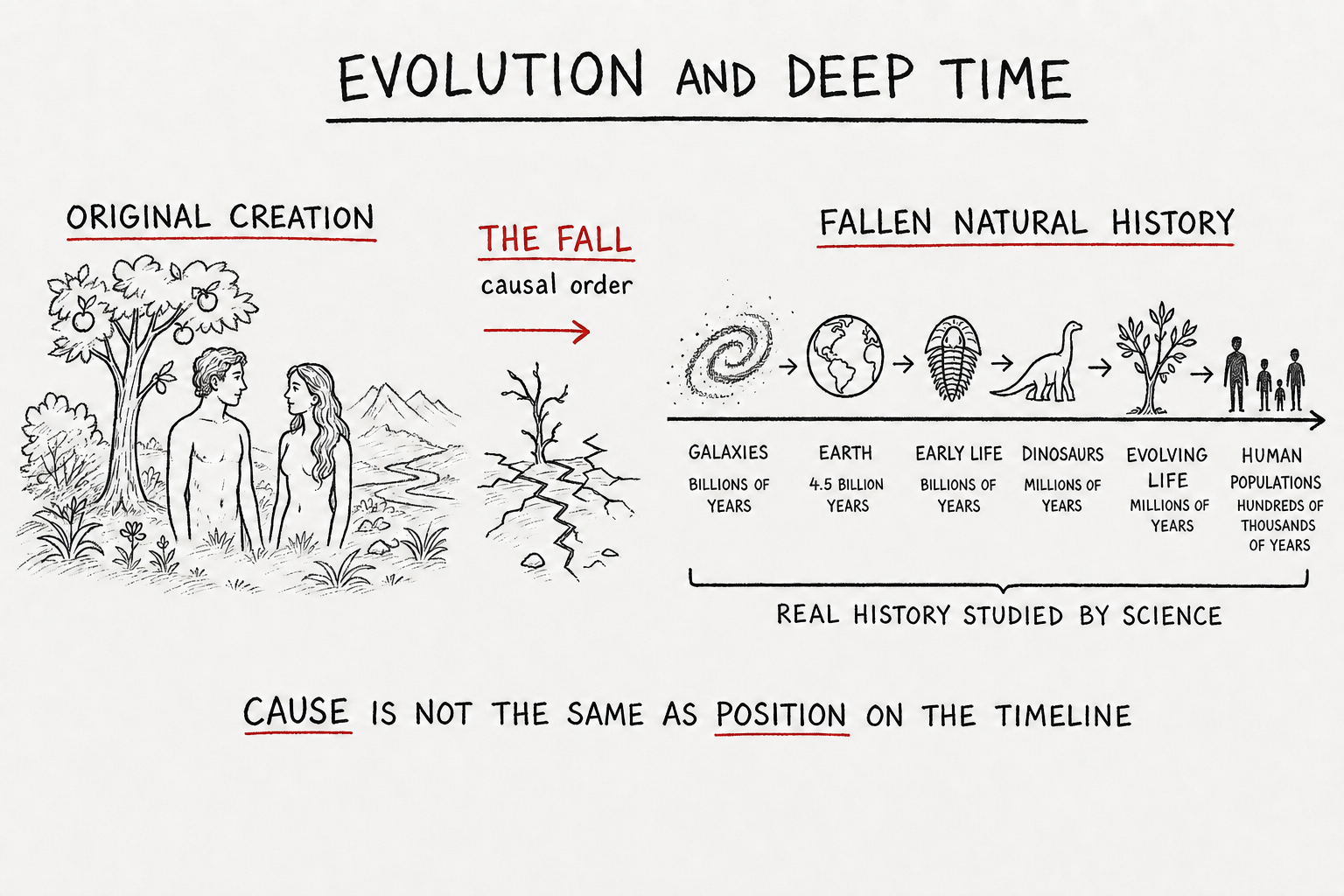
Fallen Earth Creationism does not require the Earth to be young. It does not dismiss common descent, geological deep time, extinct species, or the evidence of ancient human populations. It accepts that science describes a coherent natural history.
The distinct FEC claim concerns what that history is. FEC proposes that evolution and deep time belong to the real history of the fallen creation, not to the original order God called very good.
What FEC accepts from science
The universe is ancient. Earth formed billions of years ago. Life has changed across immense periods of time. Species share patterns of ancestry. Predation, disease, extinction, and environmental catastrophe appear throughout the record. Human beings have biological and population histories connected to earlier life.
These conclusions do not depend on one fragile argument. They arise from evidence that can be studied across astronomy, physics, geology, paleontology, biology, and genetics. FEC does not use the word *fallen* as permission to reject findings that create theological difficulty.
The natural history reconstructed by science is real within the present creation. Stars formed. Continents moved. Organisms lived and died. Populations changed. Fossils and genetic relationships are not decorative evidence of a history that never occurred.
This separates FEC from appearance-of-age explanations. A fallen creation is not a recently created stage set containing misleading records. It is an order with a complete and investigable past.
The theological difficulty of deep time
Deep time creates a theological problem because the history is not morally or biologically neutral. Long before recorded human history, organisms competed, preyed upon one another, suffered disease, and became extinct. Evolutionary adaptation often depends on death and differential survival.
Genesis describes creation as good and very good. It presents Adam and Eve's disobedience as a real rupture followed by judgment, mortality, difficult labor, conflict, a cursed ground, expulsion, and loss of access to the Tree of Life. Romans 8 describes creation as subjected to futility and awaiting liberation. First Corinthians 15 and Revelation direct Christian hope toward resurrection and the defeat of death.
Christians offer several ways of relating these themes. Some understand animal death as compatible with the original goodness of creation. Some distinguish human death from animal death. Some read Adam and the Fall primarily as theological symbols within evolutionary history.
FEC asks a different question: What if the death-filled history studied by science is already the history of fallen nature?
Original creation and fallen creation
FEC proposes that God made a real original creation that was genuinely very good. Adam and Eve, Eden, the Tree of Life, direct divine communion, and the command given in Genesis belong to that order.
Adam and Eve disobeyed God. Their Fall affected creation as well as humanity. After the Fall, they entered the present fallen order.
That fallen order has its own ancient natural history. The Big Bang, cosmic development, the formation of Earth, evolution, common descent, predation, suffering, extinction, and human populations belong inside its chronology.
The original creation and the fallen creation therefore are not two periods on one longer natural timeline. Adam and Eve did not live at the beginning of the universe studied by science and then wait while it developed. They passed from the original creation into an order whose internal history was already ancient.
The Start Here overview explains the proposal in fuller form, and the [six-movement map](/five-stage-map) shows the sequence from original creation through Fall, fallen natural history, Christ, and new creation.
Cause and chronology
The central claim is that causal order and fallen-world chronology are not identical.
The causal order is:
God creates the original good order.
Adam and Eve receive their vocation and command.
Adam and Eve fall.
The fallen creation exists because of that Fall.
Christ enters the fallen creation and defeats death.
Creation moves toward restoration.
The chronology internal to the fallen world is:
cosmic development;
the formation of stars, planets, and Earth
;
the development and diversification of life;
predation, suffering, and extinction;
ancient hominins and human populations;
Adam and Eve's entry into fallen history;
biblical and recorded history.
The Fall is causally prior to the whole fallen order even though it is not an earlier event on that order's own measurable clock. From Adam and Eve's perspective, expulsion follows their disobedience directly. From within the world they enter, the past already extends billions of years.
This is the proposal's most unusual claim, and perhaps its hardest. The distinction cannot be defended merely by repeating the phrase two timelines. FEC needs a coherent account of dependence, created order, time, and actuality.
Is evolution the method of original creation?
Within FEC, evolution belongs to fallen natural history. It is not presented as the process by which God formed Adam and Eve in the original creation.
That does not make evolution unreal or scientifically unimportant. It identifies its
place within the theological proposal. Evolution describes how life developed inside the fallen order. Adam and Eve were specially created in the original order and later entered fallen history.
FEC therefore differs from standard evolutionary creation. Both accept real evolution and deep time. Evolutionary creation commonly treats that history as God's creative process within one continuous creation. FEC treats it as the real history of the fallen order resulting from the Fall.
This difference should not be exaggerated into a scientific dispute. FEC does not offer an alternative biological mechanism. A biologist could investigate evolution in the same way whether or not FEC is true. The disagreement concerns the theological status of the history being investigated.
Natural evil and the goodness of God
FEC is partly motivated by the problem of natural evil. If predation, disease, parasitism, waste, and extinction were built into the original creative ideal, it can be difficult to explain why Scripture treats creation's bondage and death as enemies awaiting defeat.
FEC places those conditions within fallen creation. This gives the Fall cosmic reach and allows original creation to differ substantially from mortal nature.
The proposal does not eliminate the problem of evil. God still creates or actualizes a fallen order with an ancient history containing immense suffering. FEC must explain how that action relates to divine goodness, human responsibility, and God's knowledge. Moving suffering into fallen history does not make its moral significance disappear.
The advantage, if the proposal succeeds, is more limited. Suffering and death are no longer treated as the final definition of God's very good order. They belong to a creation awaiting liberation.
Human evolution and Adam and Eve
FEC allows evolved human populations to appear before Adam and Eve's arrival within fallen chronology. Adam and Eve remain real and specially created in the original order.
The relationship between them and wider humanity is unresolved. Possible accounts may involve ancestry, intermarriage, covenantal representation, vocation, or a combination of these. Every account must affirm that all human populations are fully human and equal in dignity. No proposed difference in origin can support a racial, ethnic, moral, or spiritual hierarchy.
This question is treated more directly in [A
Historical Adam and Eve in an Ancient World](/posts/historical-adam-and-eve-in-an-ancient-world).
What FEC does and does not claim
FEC claims:
• the original good creation was real;
• Adam and Eve were real and specially created;
• the Fall was real and affected creation;
• the present order is fallen;
• deep time and evolution describe real fallen natural history;
• Christ, resurrection, and new creation complete the theological account.
FEC does not claim:
• that science can observe the original creation;
• that fossils or genetics directly prove FEC;
• that evolutionary biology must be rewritten around FEC;
• that every proposed interpretation of Cain, the Flood, or later Genesis is part of the core theory;
• that the philosophical relationship between the two orders has already been fully explained.
Why the distinction matters
The ordinary creation debate often assumes that Genesis and science must describe one continuous chronology. The disagreement then concerns how to compress, stretch, reinterpret, or divide that chronology.
FEC questions the shared assumption. Science may be telling the truth about fallen nature, while Genesis tells the truth about the original creation, the human rupture, and why nature is fallen.
That proposal preserves real evolutionary history rather than denying it. It also refuses to make Adam, Eve, and the Fall disposable. Its success depends on whether the relationship between the two created orders can be stated coherently and defended from Scripture and theology.
Questions or comments? Send a message or open live chat.