
How FEC Differs from Young-Earth and Old-Earth Creationism
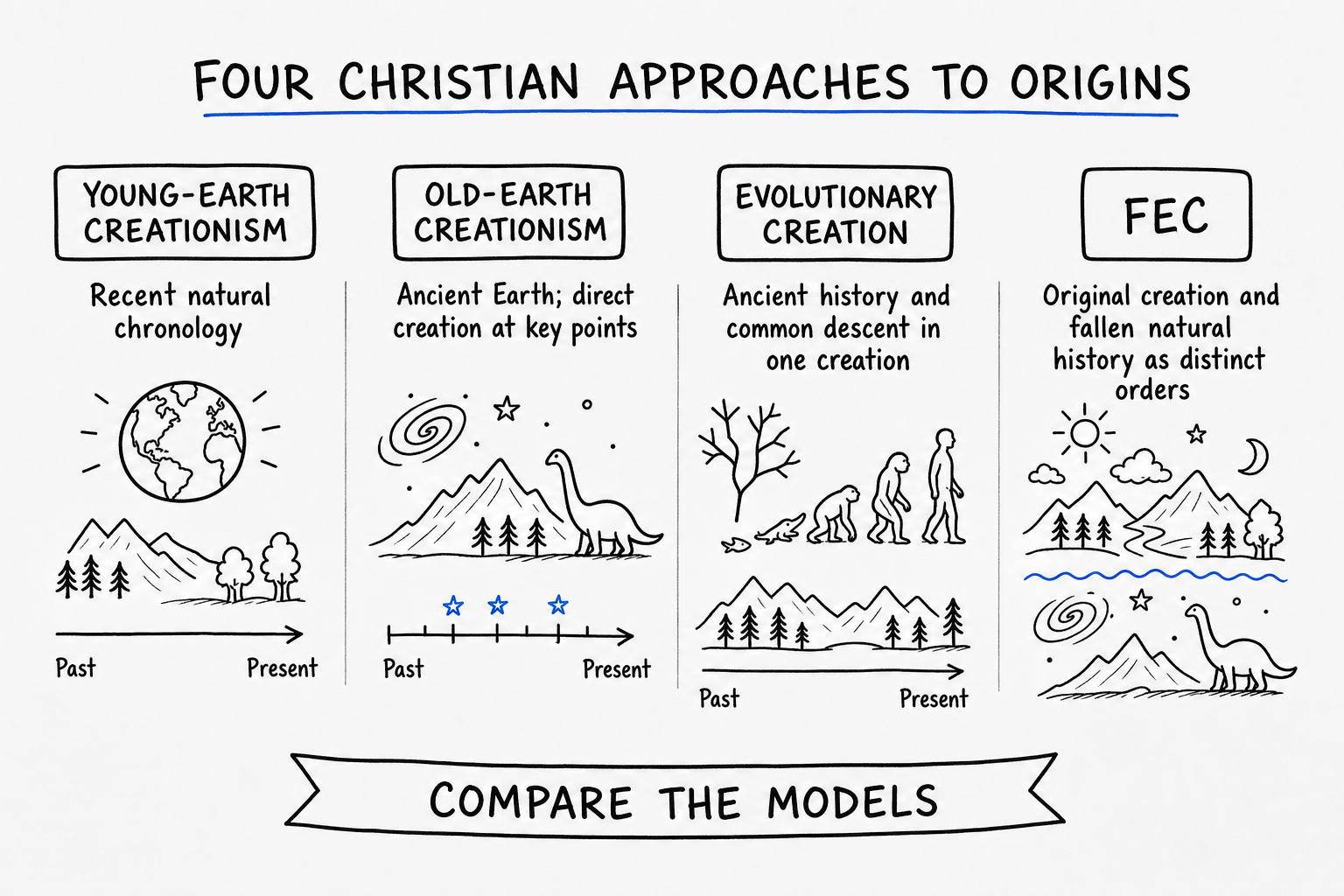
Christians who discuss origins are often asked to choose between a young Earth and an old Earth. That question matters, but it does not describe the whole disagreement. The deeper issues concern the goodness of creation, the reality of Adam and Eve, the reach of the Fall, the meaning of death in natural history, and the relationship between Genesis and science.
Fallen Earth Creationism, or FEC, approaches those issues from a different direction. It does not propose another estimate for the age of the Earth. It asks whether the original creation described in Genesis and the fallen natural order studied by science belong to one continuous history at all.
Young-earth creationism
Young-earth creationism generally reads the creation days and the early Genesis genealogies as part of a recent chronology. Adam and Eve are the first human beings, the Fall is historical, and much of the geological record is commonly associated with the Flood. Animal death, predation, and major natural disorder
are usually understood as consequences of human sin rather than features of the original created condition.
This model protects several convictions that FEC also takes seriously. Adam and Eve are real. Their disobedience matters beyond their private moral lives. Creation was genuinely good before the Fall. The world after the Fall is not simply identical to the world as God first made it.
The difficulty is scientific. Evidence for an ancient universe and Earth does not rest on one dating method or one disputed fossil. It comes from many independent fields, including astronomy, physics, geology, radiometric dating, paleontology, and genetics. FEC does not believe that evidence can be dismissed merely because it creates theological pressure.
Old-earth creationism
Old-earth creationism accepts an ancient cosmos and usually an ancient Earth while retaining direct divine creative acts at important points in natural history. Its advocates differ about the length and meaning of the Genesis days, the extent of biological evolution, and the relationship between Adam and earlier life.
This position allows Christians to accept deep time without surrendering belief in creation or divine purpose. It can also preserve a historical Adam and Eve.
Its central difficulty for FEC is the placement of suffering and death. If millions of years of predation, disease, extinction, and natural catastrophe belong to the same uninterrupted creation that God calls very good, then those conditions precede Adam's sin within that creation. Some Christians consider that theologically acceptable. FEC does not assume that it is impossible, but it asks whether Genesis and the wider biblical story point toward a more substantial difference between original and fallen nature.
Evolutionary creation
Evolutionary creation accepts the broad scientific account of cosmic and biological history, including deep time and common descent. God creates through the processes investigated by science. Genesis is commonly read as theological, literary, archetypal, or otherwise different from a modern scientific description.
This view properly recognizes that scientific evidence describes a coherent natural history. It does not require fossils, genetics, or geological layers to record events that never occurred. FEC agrees that the natural history available to science is real.
The questions arise around Adam, Eve, and the Fall. Evolutionary creationists offer several answers. Some affirm a historical couple within a larger population. Some understand Adam and Eve primarily as representatives of humanity. Some regard the Fall as a theological description of a universal human condition rather than one event that altered creation.
FEC shares evolutionary creation's willingness to accept ordinary scientific investigation, but it gives the original creation and Fall a different role. Adam and Eve are not optional symbols within FEC. They belong to an original created order, and their Fall is the reason the fallen order exists.
The central FEC proposal
Fallen Earth Creationism proposes that God made a real original creation that was very good, including Adam and Eve, Eden, the Tree of Life, and the command given in Genesis. Adam and Eve disobeyed God, and the Fall affected creation as well as humanity.
After the Fall, Adam and Eve entered the present fallen creation. This creation has its own real and ancient natural history. Cosmic development, geological deep time, biological evolution, predation, suffering, extinction, and evolved human populations belong to the history internal to that fallen order.
Science therefore studies real fallen natural history. Genesis describes the original creation, the human rupture, and the reason the present order is fallen.
The difficult part is the relationship between cause and chronology. FEC proposes that the Fall is causally prior to the fallen creation even though it is not an event located at the beginning of the fallen world's
measurable clock. Within fallen chronology, the Big Bang, the formation of Earth, the history of life, and human populations precede Adam and Eve's arrival. From Adam and Eve's perspective, their expulsion follows their disobedience directly. They do not wait through billions of years.
The six-movement FEC map presents the proposal visually.
FEC is not another age calculation
FEC accepts an ancient universe and Earth. In that ordinary sense, it is an old-earth position. Yet its defining claim is not that the days of Genesis can be stretched into geological ages or placed inside the same natural chronology.
It proposes two orders:
the original creation in which Adam and Eve were created and fell;
the fallen creation whose ancient history is investigated by science.
This distinction also separates FEC from appearance-of-age explanations. The fallen world's past is not an artificial record placed into a recently created universe. Stars formed, species evolved, animals suffered, and extinctions occurred within fallen natural history. The evidence is evidence of real
events.
What FEC shares with the other views
FEC shares young-earth creationism's insistence that Adam, Eve, and the Fall should not disappear merely because they are difficult to reconcile with science.
It shares old-earth creationism's acceptance of an ancient cosmos and concern for the continuing authority of Genesis.
It shares evolutionary creation's acceptance of ordinary scientific evidence and a real evolutionary history.
Its disagreement with each view concerns how those convictions fit together. FEC asks whether the conflict becomes less severe once original creation and fallen natural history are no longer forced onto one continuous timeline.
What remains unresolved
FEC is a theological and metaphysical proposal, not a scientific theory. It does not offer a new physical mechanism for evolution or cosmology. It also has difficult questions of its own.
How can one created order depend causally on an event that is not earlier within its internal chronology? What precisely does it mean for Adam and Eve to enter fallen history? How should their relationship to other human populations be understood? How does Adam's role in Romans 5 relate to universal human sin, death, and solidarity?
Those questions should be addressed rather than hidden. The strongest objections page identifies several of them. Readers can accept the central FEC proposal without accepting every later speculation about Cain, the Flood, human populations, or the geography of Eden.
The actual difference
The principal difference among these views is not simply a number assigned to the Earth.
Young-earth creationism places Adam near the beginning of a recent natural chronology. Old-earth creationism places Adam within an ancient creation whose earlier history already contains death and extinction. Evolutionary creation places humanity within evolutionary history and offers several accounts of Adam and the Fall.
FEC proposes that Adam and Eve experienced a real original
creation and then entered an already ancient fallen order. The scientific history remains real. Adam and Eve remain real. The Fall remains causally significant for creation. Whether that proposal succeeds depends on its biblical and philosophical coherence, not on presenting another calculation of the Earth's age.
Questions or comments? Send a message or open live chat.